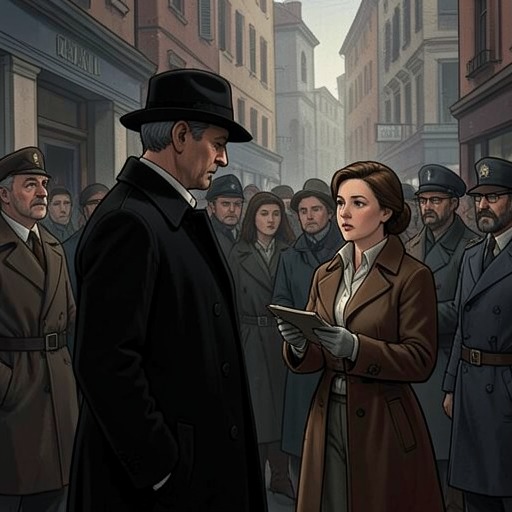
The Man in the Mist
Partners in CrimeThe Gilda Glen murder case is solved by reversing the assumption on which its apparent timeline depends: the door heard opening and shutting does not prove that the victim has just entered, because it may mark the murderer’s exit. At the White House, Gilda is found dead, while her husband, James Reilly, rushes away in visible distress. Tommy’s reconstruction of the gate, the mist, and the witnesses’ carefully checked times establishes that the person who left was the murderer—and identifies him as the policeman who had been speaking to Tommy and Tuppence.
Background and the First Clues
The case begins to take shape when an unaddressed note arrives for Tommy from Gilda Glen. Its arrival connects the investigation to Gilda, but the excerpt does not disclose the note’s contents. The decisive events follow at the White House, where Tommy and Tuppence are about to enter after speaking with a policeman who has just gone in the direction from which they came.
A faint, muffled cry comes from inside. Almost immediately, James Reilly rushes down the front steps. He passes Tommy and Tuppence without appearing to see them, muttering repeatedly and behaving as though stunned. His reaction makes him an immediate focus of suspicion, but it does not establish what he has done or what has happened inside. The house, rather than Reilly’s flight alone, holds the evidence that will clarify the scene.
Discovery at the White House
Mrs. Honeycott leads Tommy and Tuppence upstairs. On the sofa they find Gilda, motionless and dressed in black and ermine. The account describes her face as untouched, while the fatal injury is attributed to a heavy blow from a blunt instrument. Tommy examines the scene and remarks that Reilly did not strangle her after all. His observation matters because it revises the first impression of the crime: the person who has fled is not thereby shown to have killed her, and the manner of death must be distinguished from the suspicion attached to her husband.
Tommy then tests the house’s timeline rather than treating the doorway as a self-explanatory clue. Mrs. Honeycott gives an unusually precise account of when her sister came in: she was setting the clock five minutes ahead, as she did each evening, and her watch showed exactly eight minutes past six. She says her watch never gained or lost a second. Tommy compares this with the policeman’s account and with his own watch, which he had checked after he and Tuppence reached the gate. The separate time references agree closely enough to support his reconstruction.
Reversing the Doorway’s Meaning
Tommy’s breakthrough is a change in how he reads an ordinary sound. A door opening and closing can be taken as proof that an expected visitor has arrived; but the same sound can equally mean that someone has gone out. The apparent entrance is therefore not secure evidence of direction. Tommy applies this reversal to the question of whether Gilda left the house, and answers that she did not. Someone else did: the murderer.
The solution depends on treating the movements around the gate as a sequence that can be misread, not as a settled account. The policeman had appeared after stepping out of the gate, just after the mist cleared from the road. His sudden presence had startled Tommy and Tuppence, and they had spoken with him without recognizing that he could be involved. Tommy also notices the significance of the policeman’s high-pitched voice: in strong emotion, a man’s voice may sound like a woman’s. That detail helps explain how the murderer could be mistaken for a woman in the sequence of sounds and movements.
The Reconstruction and Its Consequences
Tommy’s final reconstruction is that Gilda met her husband just outside the gate and took him into the house to settle their dispute. Reilly, Tommy recalls, was given to violent speech, but the man he identifies as the murderer did not have that outlet; instead, Tommy says, he saw red and had his truncheon at hand. The policeman’s brief absence from the gate and subsequent appearance had furnished a plausible but misleading picture of an arrival. In Tommy’s account, the critical passage through the doorway was the murderer’s departure, not Gilda’s entry.
The case consequently separates three things that initially seem to point to one person: Reilly’s presence at the house, his distressed flight, and the actual killing. His behaviour draws suspicion, but Tommy’s reconstruction assigns the murder to the policeman. The next day, Reilly has been apprehended and is in custody, while his solicitor, Mr. Marvell, tells Tommy that he had never believed Reilly capable of the crime, describing him as a man of violent speech but suggesting that speech was all. This reaction shows that suspicion has already attached itself to Reilly, even as Tommy’s explanation has turned toward the policeman.
Narrative Significance
The solution makes ordinary evidence unstable without making it useless. A sound at a door, a watch reading, a figure at a gate, and a remembered encounter each provide information, but none can be interpreted correctly in isolation. The clock-setting routine gives Mrs. Honeycott’s time a specific basis; Tommy’s own watch and the policeman’s account provide points of comparison; and the mist’s clearing helps explain why the policeman’s sudden appearance startled the couple. Together, these details let Tommy distinguish the apparent sequence from the actual one.
The murder’s decisive clue is thus a reversal of direction. Tommy’s comparison to a stick, whose opposite ends point opposite ways, frames the same principle: doors open and shut, and people go upstairs and downstairs, but the observer’s chosen point of view determines what those movements seem to mean. The case resolves when Tommy asks not only who was seen, but whether the witnessed passage was an entrance or an exit. In that reversal, the policeman whom the couple had treated as an ordinary witness becomes the murderer they had already seen.